Tuesday, June 18, 2013

Tomb Sweeping Day

      On Tomb Sweeping Day, we will go back to our hometown. Most of the family will go to clean their ancestors’ tomb, and worship with respect. Maybe it will be an  exhausting day, but it also shows our attitude of respect to our ancestors and the honor of family.


Folk religion of Taiwan


About

People  who  are  up  to  80


percents of  populations  believe 

folk  religion in Taiwan.

Our  religion  belongs  to  original  


religion  in  which  there  are many Gods.

It  mixtures  ethics  of  Confucian

culture,  reincarnation  about  cause

and  effect  of  Buddhism  and

ceremony  of  Daoism .  


Festival


We  held  the  famous  festival

which is about  raising statues of

Gods to parade in Changhua ,

Taiwan .There are about 100,000

people from around the world to


join this activity.

The festival takes people

eight days to parade.

People prove their devotion by

this activity. It is held at a special time decided by

the Gods.

There is a video about the festival below:


Effect


Because our folk religion

mixes different religions

we can contain a variety of

religion and accept culture
from all over the world.


 In addition, it helps us

 preserve our local

language and tradition.


Wednesday, June 5, 2013

Landmarks of Taiwan


Taipei(1)

The Grand Hotel

The Grand Hotel is located in Jiantan Hill, Taipei, Taiwan, Republic of China. It was established after World War II, and is Taiwan's premier large international hotel. The palace-style building was completed in 1973, is one of the most famous landmarks in Taipei.

Taipei(2)

Taipei 101

Tapei 101 is a skyscraper located in Xinyi District, Taipei, Taiwan.  Story 509.2 m (1,671 ft), total floor common ground 101 floors, 5 floors underground, completed and opened on December 31, 2004. Taipei 101 is currently the world's third tallest building, the world's highest green building, the tallest building in Central seismic zone, but also the tallest building in Taiwan, East Asia and the Pacific Rim.  It has the world's second-fastest elevator inside the building.

Hsinchu

The East Gate
It was founded in the Qing Emperor Yongzheng reign (1723), was the hall where the rule of freshwater Hall, the existing masonry city was completed in 1829.Now, it is located in the center of Hsinchu City, the second monuments designated by the Ministry of the Interior of the Republic of China.
 
Taichung
Dajia Jenn Lann Temple
Commonly known as the Dajia Matsu temple, located in Taichung, Taiwan Dajia Sunchon Road No. 158, The Dajia train station in front of 200 meters, one of the well-known Mazu temples in Taiwan. Dajia Jenn Lann Temples parade develop into the grand event of the religious in Taiwan.
  
Changhua
Bagua Mountain Giant Buddha
Bagua Mountain Giant Buddha in Baguashan hillside about as big as 74 meters above sea level, it is a sit cross-legged on the 4-meter-high lotus throne of Sakyamuni Buddha, the overall height of about 23 meters, the base is about 694 m.


Tainan

Chihkan Tower
It located in the Central and Western District of Tainan City, Taiwan. Formerly known as the 1653 Dutch colonial period to build the European architecture - Provintia, the ruling center of the whole island.Today, Chihkan Tower is a mixture of the remnants of Provintia, Tanah Lot and Wenchang Pavilion.It is the first monument in Taiwan.   


Kaohsiung

Tuntex Sky Tower

It is located in Lingya District, Kaohsiung, Taiwan, next to the Port of Kaohsiung and Shinko Pier.  It is the second highest skyscraper in Taiwan. It story 347.5 meters, 378 meters high (plus antenna); 85 floors above ground and 5 floors underground, and was completed in 1997.


Dance of Taiwan


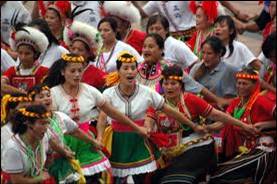
Folk dance
Our folk dance is affected by geography , climate, culture and customs, so there are a variety of cultures and different styles in it. This kind of dancing belongs to my country’s mass culture. In addition, there are some people practicing it in the park on morning. Folk dance of my country is famous for practicality in the world, which caused some experts to want to research our folk dance.


Techno dance of Nezha deity
Nezha deity is responsible for getting rid of your disease and protecting us from the devil. This dance is the best symbolization of our multi-culturism. It mixes religious ceremony, techno dance and fashion dance steps. This dance even perform in opening ceremonies of deaflympics and World Games in the past.
Our aboriginal races’ history can date back to about 6400 B.C. They may have come from China or Southeast Asia. Our aboriginal races are good at singing and dancing. Their dance is related to living. When they are happy, they dance and dance. When they are sad, they dance and sing, too.

The Night Market In Taiwan


The Night Market In Taiwan


1.What?
Night markets or night bazaars are street markets which operate at night and are generally dedicated to more leisurely strolling, shopping, and eating than more business-like day markets. They are typically open-air markets.

 2.Where?
  There are a lot of night markets in Taiwan. For example, there are many night markets in the cities of Taipei, Kaohusing, and Taichung.

 3.When?
  Every night market doesn’t trade at the same time. More night markets trade on the weekend.

 4.Who?
   We go to the night market with our family, friends, classmates, and maybe our girlfriend or boyfriend.

 5.How?
    You can take the MRT (subway) or taxi, and you can maybe take a scooter, too.
     
6.Which?  Which is the most famous night market food in Taiwan?
Oyster omelet is maybe the most famous Taiwanese food in the night market.

Products in Taiwan

 
Although Taiwan is a small island and lacks many natural resources Taiwan can boast of  its modern skills and unique originality. Before the 18th century, agriculture  is the main export product in Taiwan.  But now, with talented people and innovative ideas Taiwan has became much more international.

For example, Giant is a Taiwanese bicycle manufacturer which is recognized as the world’s largest bicycle manufacturer. At the beginning it  was only produced  in Taiwan.  As the market get more and more widespread they started  to expand  business . Japan , Netherlands, China are all their  companies’ location.  


hTC is one of the most famous  smartphones in  the world, and it is also from Taiwan. Because of its refined design and beautiful  appearance it became popular around the world.
In recent years Taiwan has had a great performance in international  invention or originality  contests.


Secure sockets is useful and safe in office , family ,and  industry application.
 
High-heeled shoes can change its heel whatever you want.
THE END

Tuesday, June 4, 2013

Religion’s Famous People


Paul Shan Kuo-hsi, S.J. (Chinese language: 單國璽; pinyin: Shàn Guóxǐ) (December 3, 1923 – August 22, 2012) was a cardinal in the Roman Catholic Church. He was at times the bishop of Hualien and Kaohsiung and the chairman of Fu Jen Catholic University. Born in Puyang, Zhili province (now Puyang, Henan province) of China. He joined Society of Jesus on September 11, 1946; took religious vows, September 12, 1948 and final vows on February 2, 1963. He was ordained on March 18, 1955 in Baguio, Philippines. He attended the St. Joseph Regional Seminary, Chiughsien; Berchmans College, Manila, where he earned a licentiate in philosophy. He went on to attend Bellarmine College, Baguio, Philippines being awarded a licentiate in theology. He also attended the Xavier University earning a diploma in education science and finally the Pontifical Gregorian University in Rome where he was awarded a doctorate in theology. Besides Mandarin, his first language, he also spoke Latin, English, French, Italian, Spanish and Portuguese.

After his ordaination to the priesthood in 1955, he did further studies in Novaliches from 1955–1957. He then served as director of the Chinese section of Sacred Heart School, Cebu from 1957–1959, after which he took time to pursue doctoral studies in Rome. He served as assistant of master of novices, Thuduc, Vietnam from 1959–1963, then Master of novices and rector of Manresa House, Changhua, Taiwan from 1963–1970. He went on to serve as rector of St. Ignatius Institute in Taipei from 1970–1976 and president of the Catholic Schools Association, Taiwan from 1972–1976.

He was appointed episcopal vicar of Taipei in 1976 holding the post until 1979. He was appointed Bishop of the Roman Catholic Diocese of Hualien, in Hualien, Taiwan, on November 15, 1979, by the late former Pope John Paul II, and after his episcopal ordination was formally installed as Bishop of Hualien on February 14, 1981. After his service there, he was transferred and appointed Bishop of the Roman Catholic Diocese of Kaohsiung, in Kaohsiung, Taiwan, also by Pope John Paul II, on March 4, 1991. He was formally installed as Bishop of Kaohsiung on June 17, 1991.

He was appointed Cardinal-Priest of the Titulus S. Chrysogoni by Pope John Paul II on February 21, 1998, and was, following the death of Cardinal Ignatius Kung in 2000, and then Cardinal John Wu in 2002, and before the elevation of Cardinal Joseph Zen, the only known living Chinese Cardinal (a Cardinal appointed in pectore by Pope John Paul II in 2003 was rumored to reside in mainland China, but that appointment expired with the Pontiff's death since the Cardinal's name was never published). He retired in January 2006, and died on Wednesday, August 22, 2012, after a battle with a pneumonia infection, having also battled lung cancer since his diagnosis in August 2006, eight months after his retirement.


Cheng Yen (traditional Chinese: 證嚴法師; pinyin: Zhèngyán Fǎshī; born 11 May 1937) is a TaiwaneseBuddhist nun (bhikkhuni), teacher, and philanthropist.She is often called the "Mother Teresa of Asia."In 1966, Cheng Yen founded the Buddhist Compassion Relief Tzu Chi Foundation, commonly known as Tzu Chi; its motto is "instructing the rich and saving the poor". Later, Cheng Yen's Charity, Medicine, Education, and Culture Missions developed, and to the present the Tzu Chi Foundation has become involved in international disaster relief, bone marrow donation, environmental protection, and community volunteering.